
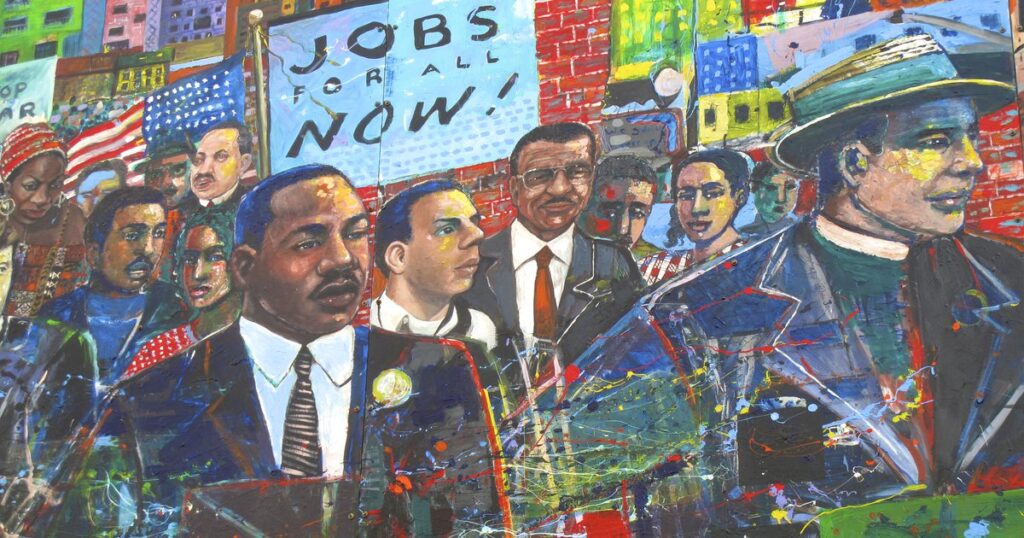
Hidden behind the pomp and circumstance of today’s political theater — buried beneath headlines about ICE raids, deportations, and the steady drumbeat of culture-war battles — lies another story that receives far less scrutiny.
For decades, corporations and government institutions have wrapped inequity in the language of progress. What was once “tolerance” has been replaced by the corporate-friendly buzzwords “diversity,” “equity,” and “inclusion.” These terms, polished for annual reports and press releases, sanitize reality. They project an illusion of progress while concealing an uncomfortable truth: the calculated erasure of Black workers from America’s labor force. The veneer of “diversity” has allowed institutions to claim success while the structural blocks for Black employees remain unchanged.
We Don’t Need Diversity Language. We Need to Name Anti-Black Policies.

Terms like diversity, equity, and inclusion (DEI) are often used in the workplace as broad umbrella concepts. But have you ever walked into a workplace that touts progressive missions? DEI means everything but black. In practice, DEI allows institutions to claim progress through non
black hires and branding — while avoiding deeper accountability for ongoing systemic inequities. And they’ve been able to do so because DEI frames issues as a matter of general inclusion rather than naming the specific forms of exclusion or harm affecting Black workers. “Diversity” implies a numbers game (how many different groups are represented), rather than addressing structural barriers that lead to disproportionate harm. By spreading attention across all categories of “diversity,” the unique and measurable impact of anti-Blackness gets hidden or minimized.
The Dichotomy in Language
Just as terms like “anti-Semitism” or “anti-Asian hate” describe specific discrimination, “anti-Black” highlights the unique and persistent systemic discrimination Black workers face.
DEI: Focuses on inclusion, representation, and optics. It allows institutions to celebrate presence without addressing harm.
Anti-Black: Focuses on exclusion, systemic bias, and disproportionate impact. It makes visible the ways Black workers are treated as expendable, even in “diverse” spaces.
If we call it “anti-Black workforce practices” (rather than “lack of diversity”), the demand shifts from “let’s add more diverse hires” to “let’s stop policies and practices that disproportionately harm Black employees.”
Stop the Illusion of Inclusion. The System is Anti-Black.
A USA Today article highlights that Black workers make up 18% of the federal workforce, and are concentrated in agencies hardest hit by cuts (e.g., 36% at the Department of Education). When layoffs target these agencies, the effect is not neutral. It amplifies an anti-Black outcome, even if no one names it as such.
Black women — 12% of the workforce — lost over 300,000 jobs as DEI protections were lifted and federal cuts disproportionately struck their domains. White men gained hundreds of thousands of positions in the same period.

Black women accounted for the only major female demographic to experience staggering job losses, losing over 300,000 positions during that span. In contrast, white men gained 365,000 jobs, while white women and Hispanic women gained 142,000 and 176,000, respectively. (BET)
Black unemployment is rising because of structural choices. This isn’t a failure of “diversity”; it’s an expression of anti-Blackness in workforce structures.
DEI Rollbacks and Federal Overhaul
On January 20, 2025, President Trump issued Executive Order 14151, dismantling all federal DEI programs — ordering the closure of offices, termination of contracts, and the purging of employees connected to DEI initiatives. The very next day, he revoked Executive Order 11246, which had required affirmative action standards for federal contractors【Wikipedia】.
These orders were paired with sweeping federal layoffs overseen by the new Department of Government Efficiency, which also stripped away due-process protections and gutted civil service appeal structures【Wikipedia】.
The consequence was swift and targeted: federal agencies where Black women are disproportionately represented — including the Department of Education (36%), USAID (21%), and the Consumer Financial Protection Bureau (CFPB) — shed massive numbers of staff【Axios】.
If these moves were truly about targeting DEI initiatives in general, the job losses would have been distributed evenly across racial and gender groups. But they weren’t. Instead, Black workers absorbed the brunt of the cuts — particularly Black women, who lost more than 300,000 jobs in just a few months. Black men also saw staggering losses, with unemployment spiking by more than 180,000 in June 2025 alone.
That disproportionality unmasks the real issue: this is not simply an anti-DEI agenda. It is anti-Black policy disguised as bureaucratic “efficiency.”Trump’s actions make clear that in today’s political landscape, DEI has become shorthand for Black workers — and eliminating DEI has become a coded way of justifying the exclusion and erasure of Black labor.
Black Workers as Canaries in the Coal Mine?
Black workers as the canary in the coal mine makes Black suffering sound like collateral damage or an early alert for others, instead of what it really is: proof of a workforce system that is anti-Black at its core. The U.S. unemployment rate may hover near 4.2%, but among Black Americans, it has surged to 7.2%—the highest since October 2021.(Wall Street Journal) Black unemployment, historically the first to rise during downturns, is a well-known early indicator of broader economic weakness.(Wall Street Journal, The Week)
The erasure is not limited to Black women. Recent labor statistics from the Federal Reserve Bank of St. Louis (based on U.S. Bureau of Labor Statistics data) reveal that between June and July 2025, the number of employed Black men over 20 years old decreased by 129,000.
- June 2025: 9,752,000 employed Black men (20+).
- July 2025: 9,623,000 employed Black men (20+).
- Net loss: 129,000 positions in just one month.
Other reports, such as HBCU Money, noted that African American men saw their number of unemployed increase by 181,000 in June 2025, with a loss of 117,000 jobs in the same period. The discrepancy highlights a critical point: whether measured in net employment declines or unemployment spikes, Black men are enduring concentrated and compounding harm.
Like Black women, Black men serve as stabilizers in America’s workforce — especially in industries like public sector service, manufacturing, and transportation. Their forced exit from stable employment not only destabilizes families but weakens entire communities.
Why “Diversity” Framing Falls Short
“DEI” language treats inequity as a problem of representation rather than power. But when Black women—despite being workforce integral—lose jobs en masse, “diversity” becomes a distraction. DEI rollbacks are not neutral pauses; they’re structural attacks grounded in anti-Black policymaking. When Black women who were laid off try to seek redress, they’re barred—with the independent worker protection board (the Merit Systems Protection Board) effectively neutered via political purge.(Wikipedia)
Economic and Systemic Consequences
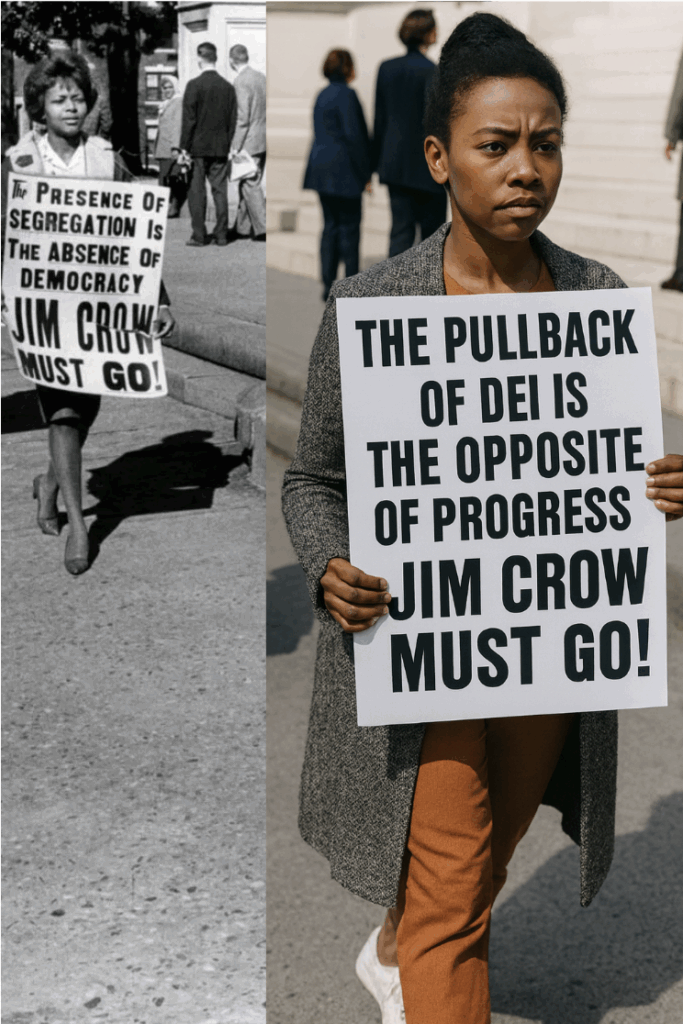
- The 300,000+ Black women exits from the labor force during the spring/summer of 2025 cost the U.S. economy over $37 billion in GDP.(The Week)
- Black women serve as economic stabilizers: they have among the highest labor force participation rates (~80%) compared to other demographics.
- When they exit, the effects ripple—harming housing stability, children’s outcomes, and consumer spending. (The Week)
- Erosion of community economic stability: Black men are heavily represented in industries like manufacturing, construction, transportation, and public sector work. Losses in these fields destabilize local economies where Black households are already concentrated. (PMC)
- Housing and neighborhood decline: With fewer Black men employed, communities face higher risks of foreclosures, evictions, and declining property values, deepening cycles of disinvestment.
- Historically and statistically, Black workers are often the first fired in downturns—a pattern shown in academic studies decades ago.
The Real Issue is Anti-Blackness in the Workplace.
The framing must shift from broad inclusion to naming exclusion. Using “anti-Black” directly identifies the dichotomy: Black workers often face targeted harms, even inside spaces that brand themselves as diverse. From mass federal layoffs that decimated agencies where Black women held key positions, to corporate rollbacks of equity programs in the name of “efficiency,” the pattern is clear: when institutions are forced to cut, Black workers are the first to go. The numbers bear this out. Black workers remain disproportionately harmed in layoffs, excluded from leadership pipelines, and treated as expendable in times of economic downturn.
DEI is the New “Blacks Need Not Apply”
The problem is not a lack of inclusion workshops or multicultural hiring fairs. The problem is systemic. Even as DEI programs became mainstream, Black unemployment has consistently outpaced that of all other workers, not just white.
That’s why DEI functions less as a tool of equity and more as a modern version of a “Blacks Do Not Apply” sign. It offers institutions cover to appear progressive while the structures that actively exclude Black workers remain intact.
But under Trump, this framework becomes even more dangerous: it offers a ready-made justification for removing Black workers altogether. By collapsing DEI into a single idea — “DEI means Black” — he can dismantle protections and gut representation under the guise of fighting “woke” politics. In effect, DEI becomes Trump’s Trojan horse. By targeting it, he gains political cover to pursue what has long been the core of American labor exclusion: limiting, devaluing, and removing Black labor while preserving the appearance of neutrality.
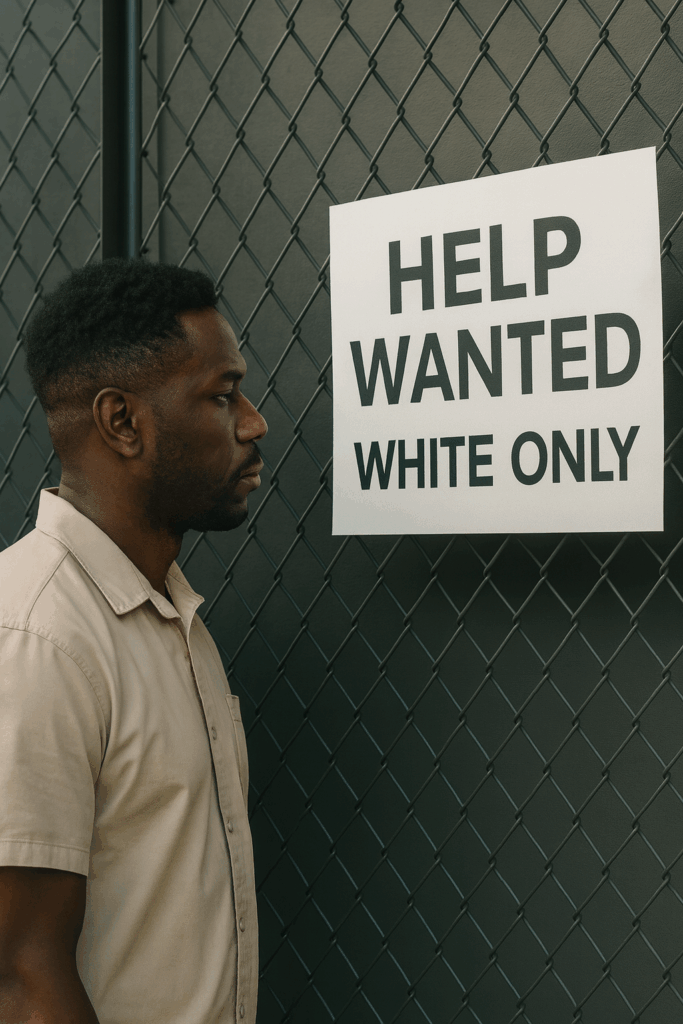
Calling this a “diversity gap” deflects responsibility. It frames the issue as a benign shortfall instead of what it truly is: the deliberate outcome of policy choices and institutional bias. The more accurate term is anti-Black. Naming it as such forces accountability. It exposes the reality that exclusion is not accidental — it is structured, repeated, and enforced.
Until the conversation shifts from euphemisms about inclusion to a direct confrontation with anti-Black systems, the cycle will continue and long after Trump leaves office. Black workers will remain on the margins, their losses dismissed as statistics instead of being recognized as symptoms of a deeper design. The question, then, is not whether America values diversity. The question is whether America is ready to stop disguising its anti-Blackness in the language of progress.
The Stakes Are Clear
We must shift the narrative: call it anti‑Black policy, demand accountability, and rebuild a genuinely equitable workforce—not just a diverse facade. To move the needle, we must stop hiding behind neutral words like “diversity” and start naming the actual harm: anti-Blackness in workforce structures, hiring, retention, and job security. Only then can accountability and structural change follow. Neutral language like “diversity” and “inclusion” obscures the reality that Black workers are being targeted, harmed, and expelled from the labor force at disproportionate rates. Until we stop hiding behind euphemisms and name these policies as anti-Black, we will not demand accountability for the deliberate dismantling of Black economic stability.
Further Reading & Sources:
- Federal job dynamics and DEI rollbacks: Axios (Black women unemployment rising)(Axios); The Week (300,000 Black women pushed out)(The Week); Houston Chronicle (labor force exodus & economic impact)(Houston Chronicle)
- Job gains/loss breakdowns by group: BET article (Katica Roy data)(BET)
- Systemic patterns of racial labor volatility: Economic research (last hired, first fired dynamic)(PMC)
- Legal and structural dismantling of protections: Exec Orders 14151 & revocation of 11246(Wikipedia); Mass layoffs & Merit Board purge(Wikipedia)



Leave a Reply